
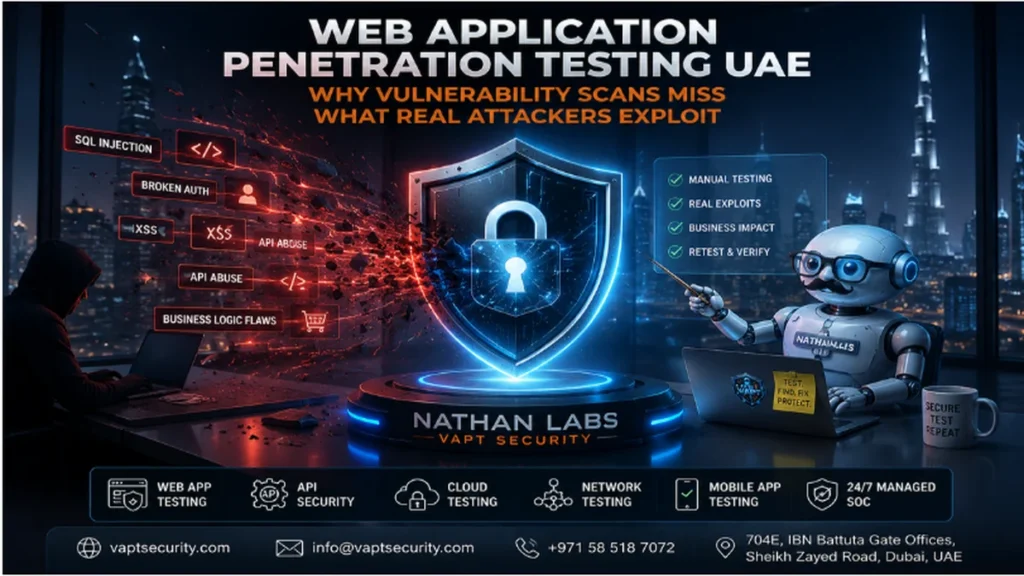
Every login page, payment gateway, API, and admin dashboard your business runs is a potential way in for an attacker. A vulnerability scanner can tell you a server is missing a patch. What it can’t tell you is whether that missing patch, combined with a weak session token and an overly permissive API endpoint, adds up to a full account takeover. That gap between “vulnerability exists” and “vulnerability is exploitable” is exactly what web application penetration testing is built to close.
For businesses across Dubai, Abu Dhabi, and Sharjah running cloud-native platforms, third-party integrations, and CI/CD pipelines pushing new code weekly, that gap only keeps growing. Whether you’re searching for web application penetration testing UAE or broader VAPT services, the underlying question is the same: can someone actually break in, and what would they reach if they did?
Quick Answer
Web application penetration testing is a manual, controlled security assessment that simulates real attacker behavior against your application, not just to list flaws, but to prove whether they can be exploited and what damage they could cause. It’s one part of a full VAPT program, which combines vulnerability assessment with hands-on exploitation testing across your applications, APIs, and infrastructure.
Why Scanners Alone Aren't Enough
Automated scanners are good at what they’re built for: finding known CVEs, outdated libraries, and misconfigurations at scale. What they can’t do is understand context.
Real breaches rarely come from one critical bug. They come from small, individually low-risk issues chained together: a weak password policy enabling credential stuffing, which grants an authenticated session, which exposes a predictable user ID, which leads to an IDOR bug, which escalates to admin access. Each step alone might look like a “medium” finding on a scan report. Strung together, it’s a full breach. A scanner checks boxes; a human tester follows that chain the way an attacker would, which is the core difference between a vulnerability assessment and real application security testing.
What Attackers Actually Do
Attackers don’t open a scanner and look for “critical” tags. They recon the app, map out how authentication and sessions behave, probe the APIs behind the UI, test file uploads and input validation, and look for the shortest path to sensitive data or admin control. Good penetration testing follows that same logic; it’s less a checklist and more a methodology, covering initial access, privilege escalation, and lateral movement rather than a single flaw in isolation.
Two-Area Scanners Consistently Miss
Authorization, not just authentication. Authentication answers, “Who are you?” Authorization answers, “What should you be allowed to touch?” Most serious breaches, viewing another customer’s invoice, editing someone else’s account, and reaching an admin function you shouldn’t see come from broken access control, not a software bug. Scanners are bad at this because it depends entirely on your application’s logic, not a known signature.
Business logic. Things like reusing a discount code, skipping an approval step, or manipulating a subscription tier aren’t “vulnerabilities” in the traditional sense; they’re the application working exactly as coded, just not as intended. No scanner flags this. Only a human tester who understands the workflow will.
APIs Deserve Equal Attention
Most modern apps expose more functionality through their APIs than through the visible UI. It’s common for a website to correctly block access to another user’s data, while the API behind it allows the same access with a modified parameter. This is why API security testing covers authentication, object-level authorization, rate limiting, and data exposure need to run alongside application testing, not after it.
Cloud and Network Layers Add More Ground to Cover
If your app runs on AWS, Azure, or a hybrid setup, the provider secures the underlying infrastructure, but IAM permissions, storage bucket access, secrets management, and container configuration are still on you. That’s where cloud security testing comes in, evaluating misconfigurations and identity controls that the application layer alone won’t surface.
The same logic applies below the application: internal systems, VPNs, firewalls, and exposed services are commonly assessed through network and infrastructure penetration testing, which is a natural complement to web application testing for organizations running network penetration testing in Dubai alongside their app security program.
What a Solid Engagement Should Cover
- Authentication and session management
- Authorization and access control
- Business logic abuse cases
- API security (auth, object-level access, rate limiting)
- Input validation and injection testing
- File upload handling
- Sensitive data exposure
- Security configuration and headers
- Retesting after fixes are deployed
If a proposal skips retesting, that’s a red flag confirming a fix actually worked is half the value of the engagement. Nathan Labs builds retesting and closure into every assessment rather than treating it as a paid extra.
How Often Should You Test?
Annual testing made sense when releases were quarterly. With weekly or daily deployments, a test from ten months ago tells you very little about your current attack surface. This is the gap continuous penetration testing (PTaaS) is built for: testing on a regular cycle tied to your release schedule instead of a single point-in-time report, so a full annual assessment stays backed by ongoing visibility in between.
Beyond the Web Application
Web application testing is usually one piece of a wider assessment. Depending on your stack, it’s worth pairing with:
- Web and mobile app security testing if you also ship a mobile app
- Application security testing (SAST & DAST) to catch issues earlier in the development cycle
- DDoS resilience and stress testing if login, checkout, or API endpoints need to hold up under traffic spikes
- 24/7 Managed SOC if you need ongoing monitoring between testing cycles, not just periodic assessments.
Regulated sectors like banking and fintech, healthcare, and government typically need testing scoped to their specific compliance requirements rather than a generic checklist; see our industries served for what that looks like by sector.
Choosing a Provider
Before signing off, ask a few direct questions:
- Is it a testing manual, or just an automated scan with a report wrapped around it?
- Are APIs and cloud infrastructure explicitly in scope, not just the browser-facing app?
- Do they include remediation guidance a developer can actually act on?
- Is retesting included once fixes are in?
If the answer to any of these is vague, keep looking.
FAQ
What's the real difference between a scan and a pentest?
A scan tells you what’s outdated or misconfigured. A pentest tells you whether an attacker could actually use that to get in and what they’d reach once inside.
Does web application testing cover APIs and cloud infrastructure too?
Web application testing itself focuses on the app layer. APIs and cloud infrastructure are typically scoped as separate but complementary assessments; see the links above, so make sure your provider is testing all three, not just the UI.
Is this only necessary for compliance?
No. Compliance is often the reason testing gets budgeted, but the actual value is catching exploitable risk before it becomes an incident.
Will testing disrupt our production environment?
A well-scoped engagement agrees on timing and methodology upfront specifically to avoid this.
Get an Assessment
Nathan Labs runs manual VAPT services across web applications, APIs, cloud, and network infrastructure for businesses across the UAE, with practical remediation guidance and retesting included once fixes are deployed.