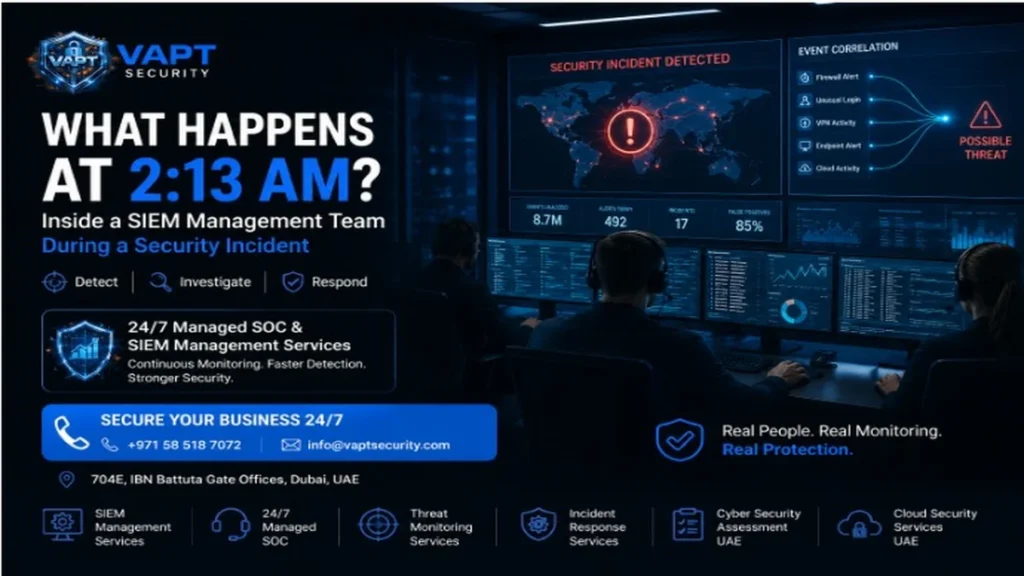
At 2:13 AM, the office is empty.
Meeting rooms are dark. Workstations sit idle. Employees are asleep.
But inside a Security Operations Center (SOC), the night has only just begun.
A notification appears on an analyst’s dashboard:
“Unusual Authentication Activity Detected.”
At first glance, it doesn’t look alarming.
No ransomware.
No servers crashing.
No website outage.
Just one authentication event among millions of logs collected throughout the day.
Most organizations generate thousands or even millions of security events every 24 hours. Firewalls, cloud platforms, VPN gateways, Active Directory, Microsoft 365, endpoint protection, and business applications continuously produce logs. Individually, these events rarely tell a meaningful story.
The challenge is identifying the few that matter before an attacker turns a small anomaly into a major incident.
This is where SIEM Management Services become essential, not simply by collecting logs, but by transforming scattered security events into actionable intelligence.
2:14 AM: One Alert Is Rarely Enough
The analyst doesn’t react immediately.
Experienced SOC teams know that a single alert rarely provides enough context.
Instead of asking,
“Is this attack real?”
The first question becomes,
“What else is happening across the environment?”
The SIEM platform immediately begins correlating information from multiple security technologies.
It compares authentication records against:
- Firewall logs
- VPN activity
- Endpoint detection events
- Identity providers
- Cloud workloads
- Email security gateways
- Threat intelligence feeds
Individually, none of these systems has the complete picture.
Together, they begin telling a story.
This ability to correlate information from multiple sources is what makes Security Information and Event Management platforms far more valuable than simple log storage solutions.
2:16 AM: Patterns Begin to Emerge
The login itself isn’t unusual.
The employee often works remotely.
However, the SIEM notices something unexpected.
Only minutes before the successful login, there were several failed authentication attempts from a different location.
Meanwhile, another security product reports unusual PowerShell activity on the same user’s workstation.
A cloud monitoring platform records new access to administrative resources that the employee doesn’t normally use.
Each event, viewed independently, appears relatively low risk.
When correlated together, they suggest a possible account compromise.
Without centralized monitoring, these isolated events might never have been connected.
This is one reason organizations increasingly invest in Managed SIEM Services rather than relying solely on individual security tools.
2:18 AM: Separating Noise from Risk
One of the biggest challenges facing every Security Operations Center (SOC) is alert fatigue.
Modern organizations receive an overwhelming number of security notifications every day.
Many are harmless.
Some result from routine software updates.
Others are triggered by legitimate employee activity.
Only a small percentage indicate genuine threats.
A mature SIEM environment continuously improves detection by tuning correlation rules, reducing unnecessary alerts, and prioritizing events that require immediate attention.
This allows analysts to spend less time investigating false positives and more time responding to meaningful security incidents.
Technology generates alerts.
People provide judgment.
Effective SIEM Management Services combine both.
2:21 AM: The Timeline Changes
Three minutes later, another alert appears.
A VPN session associated with the same user begins transferring an unusually large volume of data.
At almost the same time, endpoint protection detects an unsigned executable attempting to access sensitive directories.
The SIEM automatically links these events to the original authentication anomaly.
The investigation changes immediately.
Instead of reviewing unrelated alerts, analysts now see a connected sequence of events unfolding across multiple systems.
This correlation significantly reduces investigation time and improves decision-making during the early stages of an incident.
2:24 AM: Context Is Everything
Raw security logs rarely answer the most important question:
“Should we respond right now?”
Context provides the answer.
The analyst reviews additional information:
- Has this user travelled recently?
- Is the device managed by the organization?
- Has the IP address appeared in threat intelligence databases?
- Is multi-factor authentication enabled?
- Has similar activity occurred previously?
- Are other users showing comparable behavior?
This broader context helps distinguish legitimate business activity from suspicious behavior.
Effective Threat Monitoring Services depend not only on technology but also on experienced analysts who understand how attacks develop over time.
2:27 AM: The Decision Window
By now, approximately fourteen minutes have passed since the first alert.
No dramatic headlines.
No visible disruption.
No public signs that anything unusual is happening.
Yet behind the scenes, analysts have already reconstructed a possible attack timeline using authentication records, endpoint telemetry, firewall activity, VPN sessions, and cloud logs.
Every minute matters.
Respond too early, and business operations may be interrupted unnecessarily.
Respond too late, and attackers may establish persistence, move laterally through the network, or access sensitive information.
The next decision will determine which direction this incident takes.
2:30 AM: Containment Begins
By now, the investigation has moved beyond observation.
The Security Operations Center (SOC) has enough evidence to believe the activity requires immediate action.
Rather than shutting down entire systems, analysts begin with carefully controlled containment measures.
The compromised account is temporarily disabled.
Active sessions are terminated.
Authentication tokens are revoked.
The affected endpoint is isolated from the corporate network while preserving forensic evidence.
Firewall rules are updated to block suspicious connections, and cloud access policies are reviewed to prevent further unauthorized activity.
Every action is designed to balance two objectives:
- Stop the attacker.
- Minimize disruption to legitimate business operations.
This coordinated response is where Incident Response Services and SIEM Management Services work together. A SIEM identifies and correlates suspicious activity, while incident response teams validate the findings, contain the threat, and guide recovery.
2:36 AM: Was It an Attack or a False Alarm?
Not every investigation ends with a confirmed breach.
Sometimes the unusual login belongs to an employee travelling overseas.
Sometimes a scheduled automation process generates unexpected activity.
Occasionally, a cloud service behaves differently after a software update.
Experienced analysts know that security is about evidence, not assumptions.
The value of a mature SIEM environment isn’t simply detecting attacks; it’s reducing uncertainty quickly enough that organizations can make informed decisions.
Every investigation improves future detection by refining correlation rules, reducing unnecessary alerts, and strengthening monitoring capabilities.
This continuous improvement is one reason organizations invest in Managed SIEM Services instead of deploying a SIEM platform without dedicated operational support.
The Biggest Misconception About SIEM
Many organizations believe purchasing a SIEM platform automatically improves security.
Unfortunately, that’s rarely the case.
A SIEM is only as effective as the people and processes behind it.
Without continuous tuning, log normalization, correlation rule development, and analyst oversight, even the most advanced platform can generate thousands of alerts with very little operational value.
Common challenges include:
- Critical logs never being onboarded
- Poorly configured detection rules
- Duplicate or noisy alerts
- Missing cloud visibility
- Unreviewed privileged account activity
- Alert fatigue among security teams
These issues don’t usually indicate that the technology has failed.
They indicate that the platform isn’t being actively managed.
Managed SIEM vs Self-Managed SIEM
Self-Managed SIEM | Managed SIEM Services |
|---|---|
Internal team manages monitoring | Dedicated security specialists continuously manage operations |
Rule tuning performed occasionally | Continuous optimization and correlation improvements |
Limited monitoring outside business hours | Supports ongoing monitoring based on agreed service coverage |
Investigation depends on internal resources. | Experienced analysts investigate and prioritize alerts. |
Greater operational overhead | Reduced burden on internal IT teams |
For many organizations, technology alone isn’t the challenge.
Maintaining the expertise, processes, and operational consistency required to operate it effectively is.
Why 24/7 Visibility Matters
Cyber threats don’t follow office hours.
Credential theft, automated attacks, ransomware deployment, and unauthorized cloud activity often occur during evenings, weekends, or public holidays when internal teams have limited visibility.
This is why many organizations complement their security strategy with a 24/7 Managed SOC, ensuring that alerts continue to be monitored, investigated, and escalated according to defined response procedures.
Continuous monitoring doesn’t eliminate cyber risk.
It helps reduce the time between detection and response, one of the most important factors in limiting the impact of security incidents.
Modern SIEM Extends Beyond the Corporate Network
Today’s enterprise environments extend far beyond traditional office infrastructure.
A typical organization may operate across:
- Microsoft 365
- Azure or AWS cloud environments
- VPN gateways
- Firewalls
- Endpoint protection platforms
- SaaS applications
- Identity providers
- Email security gateways
- Business-critical web applications
Each technology produces valuable security telemetry.
Effective Cloud Security Services UAE and SIEM operations help connect these independent sources into a unified operational view, enabling analysts to identify relationships that isolated monitoring tools may overlook.
SIEM Is One Layer of a Broader Security Strategy
Security monitoring is most effective when combined with proactive security validation.
Organizations often strengthen their overall cybersecurity posture by combining SIEM with:
- Cyber Security Assessment UAE to evaluate overall risk exposure.
- Vulnerability Assessment and Penetration Testing (VAPT) to identify exploitable weaknesses.
- Threat Monitoring Services to continuously observe suspicious activity.
- Cloud Security Services UAE to assess cloud infrastructure.
- Incident response planning to improve organizational readiness.
These capabilities work together to help organizations move from reactive monitoring toward a more resilient security program.
FAQ
What do SIEM Management Services do?
SIEM Management Services help organizations collect, correlate, analyze, and prioritize security events from multiple technologies. The goal is to improve threat detection, reduce alert fatigue, and support timely security investigations.
What's the difference between SIEM and a Security Operations Center (SOC)?
A SIEM is a technology platform that centralizes and analyzes security data.
A Security Operations Center (SOC) is the team responsible for monitoring, investigating, and responding to security events using tools such as SIEM platforms.
Do SIEM platforms prevent cyberattacks?
SIEM solutions improve visibility and help identify suspicious activity, but they do not prevent every attack. Their effectiveness depends on proper configuration, continuous management, and well-defined incident response processes.
Why is continuous monitoring important?
Modern environments change constantly. Continuous monitoring helps organizations detect unusual activity more quickly, reducing the time available for attackers to establish persistence or expand access.
Conclusion
At 2:13 AM, the first alert looked insignificant.
By 2:30 AM, multiple security systems had revealed a connected sequence of events that no individual technology could have identified on its own.
That is the real value of SIEM Management Services.
They don’t simply collect logs.
They provide context.
They connect isolated events.
They help security teams focus on what truly matters while reducing the noise generated by today’s increasingly complex IT environments.
As organizations continue adopting cloud platforms, hybrid work, SaaS applications, and distributed infrastructure, effective security monitoring becomes less about watching dashboards and more about understanding relationships between events.
Technology generates data.
Experienced analysts transform that data into informed security decisions.
Strengthen Your Security Operations with Nathan Labs
Nathan Labs provides cybersecurity services that help organizations strengthen their security posture through structured assessments, threat monitoring, cloud security reviews, penetration testing, and security validation. By combining skilled analysts with proven security processes, organizations can improve visibility into evolving threats and respond more effectively to suspicious activity.