
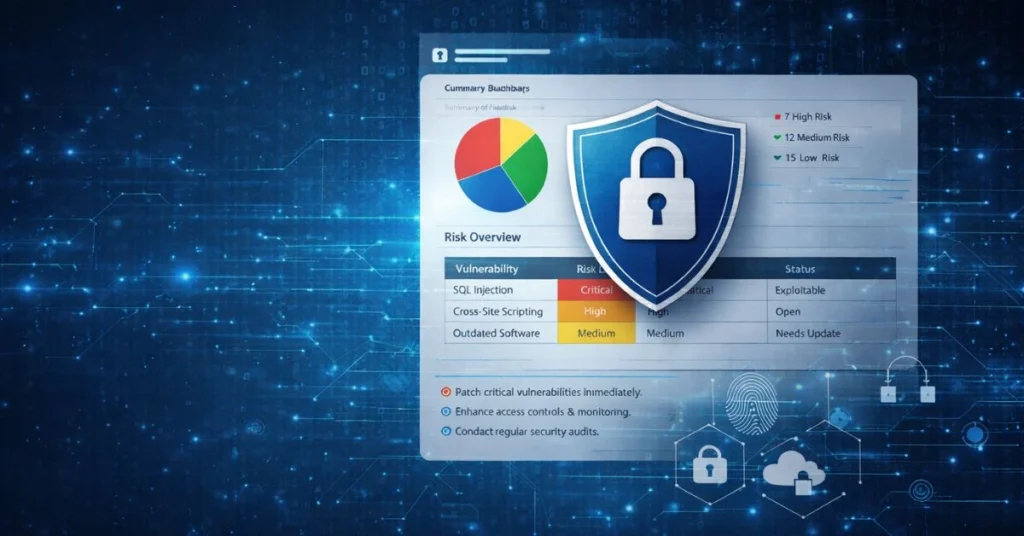
VAPT reports and how to read them have become central to how organisations interpret and respond to today’s complex cybersecurity risks. As digital infrastructure expands across sectors, these reports serve not merely as technical outputs but as critical instruments for informed decision-making. Yet, despite their importance, many stakeholders struggle to extract meaningful insights from them. The gap between technical findings and strategic action remains a persistent concern.
The Growing Importance of Security Reports
The rise of cybersecurity audits in the UAE and similar global initiatives reflects an increasing awareness of digital risk. Organisations today rely on structured outputs from penetration testing in Dubai and vulnerability assessment in the UAE to understand their exposure. However, the true value of these efforts lies not in conducting tests, but in interpreting their results effectively. A poorly understood report can lead to delayed action, leaving systems vulnerable despite prior assessment.
Moreover, as compliance requirements tighten and regulatory expectations evolve, the demand for clarity in reporting has intensified. Decision-makers now expect reports that bridge technical depth with operational relevance.
Anatomy of a VAPT Report
A typical VAPT report is structured to provide layered understanding, moving from high-level summaries to detailed technical findings. The executive summary offers a snapshot of risks, often guiding leadership decisions. The core sections, however, demand closer attention.
Key components usually include:
- Executive summary outlining overall risk posture
- Scope and methodology explaining testing boundaries
- Detailed vulnerability findings with technical descriptions
- Risk ratings (CVSS scores) for prioritisation
- Remediation recommendations for corrective action
Reports generated through VAPT services in Dubai or similar engagements often vary in format, but these foundational elements remain consistent. Understanding this structure is the first step toward meaningful interpretation.
Interpreting Risk Beyond Numbers / CVSS Sores
While numerical scoring systems provide a sense of urgency, they do not tell the full story. A critical vulnerability may not always pose immediate business risk, while a medium-level issue in a sensitive system could be far more damaging. This nuance is often overlooked when reading VAPT reports and how to read them superficially.
Effective interpretation requires:
- Contextualising vulnerabilities within business operations
- Understanding exploitation feasibility, not just severity
- Identifying patterns rather than isolated issues
Security teams working across VAPT services in Abu Dhabi or VAPT in Sharjah increasingly emphasise contextual risk analysis over raw scoring. This shift reflects a broader evolution in cybersecurity thinking—from reactive patching to strategic risk management.
Bridging Technical Findings and Action
One of the most significant challenges lies in translating findings into actionable steps. Technical teams may understand the depth of an issue, but without clear prioritisation and communication, remediation efforts can stall. This is where structured reading becomes essential.
A practical approach includes:
- Starting with high-risk vulnerabilities affecting critical systems
- Reviewing proof-of-concept details to understand real-world impact
- Aligning fixes with organisational priorities and resources
The ability to connect findings with operational realities distinguishes effective security practices from routine compliance exercises.
Strategic Value of VAPT Insights
Over time, VAPT reports and how to read them have evolved from purely technical documents into strategic tools. They now inform board-level discussions, influence investment decisions, and shape long-term security planning. This transformation reflects the growing recognition of cybersecurity as a business enabler rather than a cost centre.
As organisations mature, the emphasis shifts from simply identifying vulnerabilities to building resilience. Reports are no longer endpoints; they are part of an ongoing cycle of assessment, remediation, and improvement.
Conclusion
VAPT reports and how to read them ultimately represent more than a technical exercise—they embody an organisation’s approach to understanding and managing risk. When read with clarity and context, these reports can guide meaningful action, strengthen security posture, and support informed decision-making. In an era where digital threats are both persistent and evolving, the ability to interpret such reports effectively is not optional; it is essential to organizational resilience and long-term stability.
Don’t let critical security insights sit idle. Start translating your VAPT findings into clear priorities, decisive actions, and measurable improvements so your organization stays ahead, not just aware, of emerging threats.
