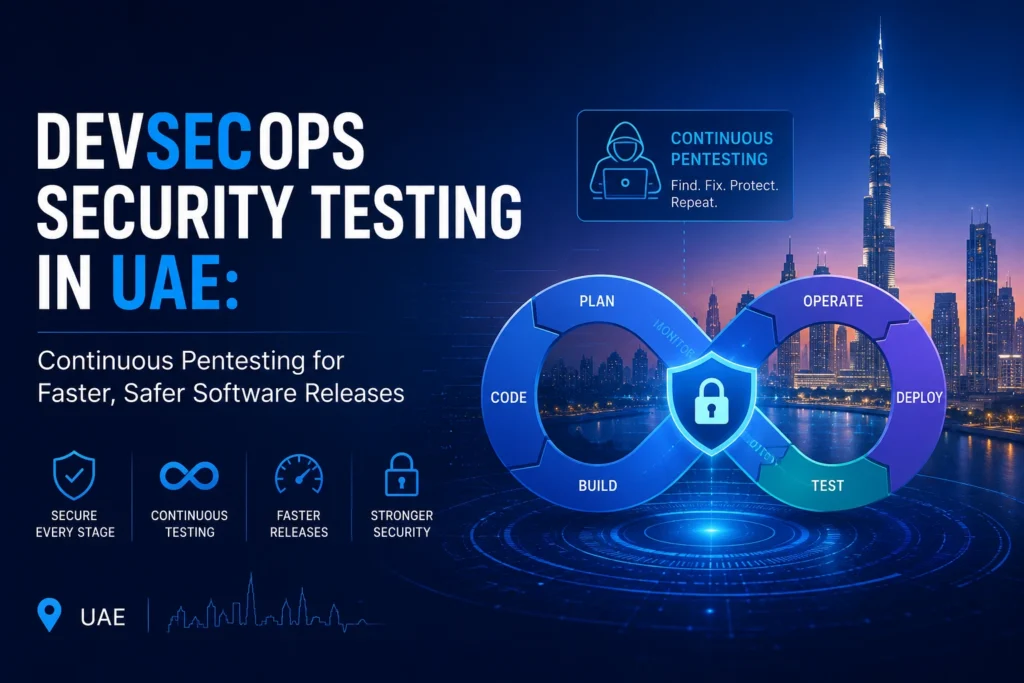
UAE fintechs and SaaS companies now ship code weekly, sometimes daily, but most still test security only once a year. That gap is where breaches happen. DevSecOps closes it by building security checks into every stage of development, instead of bolting them on after release.
This guide explains what DevSecOps security testing in UAE actually involves, why continuous pentesting matters more than annual audits, and how UAE businesses can implement it without slowing down their release cycle.
What Is DevSecOps Security Testing?
DevSecOps integrates security testing directly into the software development lifecycle (SDLC), rather than treating it as a final checkpoint before release. Every code commit, build, and deployment is automatically checked for vulnerabilities so issues are caught in minutes, not months.
Traditional security testing happens at the end of development, which creates two problems:
- Vulnerabilities pile up undetected for weeks, and fixing them late in the cycle costs far more than catching them at the point of code commit. A SQL injection flaw caught during a code review takes minutes to fix. The same flaw discovered in production after a breach can mean weeks of incident response, regulatory reporting under UAE PDPL, and reputational damage that’s much harder to undo.
- DevSecOps shifts that detection point left to the moment code is written. So development, security, and operations teams work from the same pipeline instead of handing problems back and forth after the fact.
How Continuous Pentesting Fits Into DevSecOps
Modern applications change constantly. A business shipping new code every week can’t rely on a penetration test that happens once a year; by the time that report is delivered, the application has already moved on.
Continuous Pentesting (often delivered as penetration testing as a service, or PTaaS) solves this by running ongoing assessments that keep pace with your release schedule. Instead of one large audit annually, your team gets regular, smaller-scope testing that catches vulnerabilities introduced by recent changes before they reach production.
This is the practical core of DevSecOps: security testing that moves at the same speed as your deployments, not slower.
DevSecOps testing typically spans three layers of your stack: application code, APIs, and cloud infrastructure. Each layer has its own testing approach; read our dedicated guides on API Security Testing and Cloud Security Testing for a deeper look at how each is assessed.
Does DevSecOps Replace Traditional Penetration Testing?
No, and this is a common misconception. DevSecOps automates continuous, lightweight checks throughout development (static analysis, dependency scanning, automated security gates in CI/CD). Periodic, expert-led penetration testing still matters because human testers find business-logic flaws, chained vulnerabilities, and creative attack paths that automated tools miss.
The two work together: automated checks catch the everyday issues fast, and scheduled expert assessments catch what automation can’t.
Is DevSecOps Required for UAE Regulatory Compliance?
DevSecOps isn’t explicitly named as a requirement in frameworks like NESA, DESC ISR, or UAE PDPL, but the outcomes it produces (continuous risk visibility, documented remediation, and secure software practices) directly support compliance with all three. Organizations preparing for NESA or DESC audits, or handling personal data under PDPL, are increasingly expected to show ongoing security testing rather than a single annual report. A DevSecOps approach makes that evidence trail far easier to produce.
How VAPT Security Implements DevSecOps Testing in UAE
We work with UAE development teams to embed security checks directly into their CI/CD pipelines, covering application code, APIs, and cloud configurations, alongside scheduled expert-led penetration testing for deeper validation. Every finding comes with clear, developer-friendly remediation guidance, and every fix is verified through retesting before sign-off.
Frequently Asked Questions
What is DevSecOps Security Testing?
DevSecOps Security Testing integrates security checks throughout the software development lifecycle instead of testing only before release, enabling continuous vulnerability detection and faster remediation.
Why is continuous security testing in UAE important?
It identifies vulnerabilities introduced by every new code update, reducing the risk of security incidents and helping organizations maintain secure development practices as they ship faster.
Which businesses need DevSecOps security testing?
Any organization building web applications, mobile apps, cloud-native platforms, APIs, SaaS products, or enterprise software benefits from DevSecOps, especially teams releasing code frequently.
How often should penetration testing be performed under a DevSecOps model?
Continuous or recurring testing is recommended, ideally aligned with your release cadence, so newly introduced vulnerabilities are caught as soon as they appear.
Does DevSecOps replace traditional penetration testing?
No. DevSecOps automates continuous checks within development, while periodic expert-led penetration testing provides deeper validation that automated tools can’t replicate.
Is DevSecOps required for UAE regulatory compliance (NESA, PDPL)?
It isn’t named explicitly in these frameworks, but the continuous risk visibility and documented remediation it produces directly support NESA, DESC, and PDPL compliance efforts.
Ready to Secure Your Development Pipeline?
Building secure software requires more than fast development; it requires continuous security at every stage of the lifecycle. VAPT Security helps UAE organizations integrate DevSecOps testing into their existing workflow, reducing risk without slowing down releases.