Continuous Penetration Testing vs Traditional VAPT is becoming one of the most important cybersecurity discussions in 2026. As organizations accelerate cloud adoption, CI/CD deployments, and digital transformation initiatives, choosing the right security testing approach has become critical. The cybersecurity landscape has reached a point where traditional, periodic vulnerability assessment and penetration testing (VAPT) engagements are no longer sufficient to defend against the velocity of modern threats.
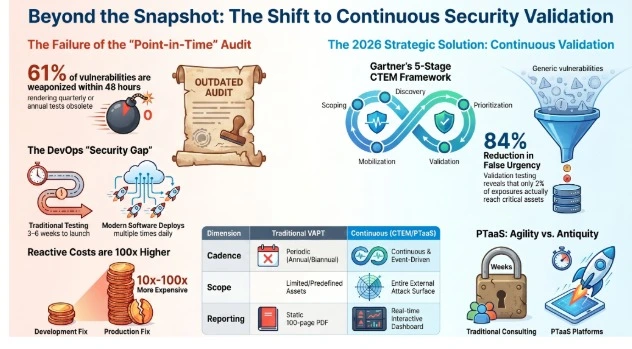
Key findings indicate that while traditional penetration testing services in the UAE offer deep human insight, their “snapshot” nature creates significant security gaps, often leaving vulnerabilities undetected for months as organizations move toward rapid CI/CD cycles and cloud-native deployments. Research suggests that 85% of SaaS businesses now update their software at least once a month, yet security assessments frequently remain quarterly or annual.
The emergence of CTEM provides a structured five-stage framework—scoping, Discovery, Prioritization, Validation, and Mobilization—to align cybersecurity investments with business risk. Furthermore, integrating AI-powered testing, continuous penetration testing, and automated validation into the development lifecycle can significantly reduce false urgency, improve remediation efficiency, and strengthen overall cyber resilience.
The traditional “annual physical” model of cybersecurity—engaging a provider once a year for web application penetration testing, network penetration testing, or infrastructure reviews—is increasingly viewed as inadequate. Modern organizations operate in dynamic cloud environments where applications, APIs, and infrastructure change continuously, making point-in-time reports outdated shortly after delivery.
In 2026, the timeline between vulnerability disclosure and exploitation has collapsed dramatically.
Traditional assessments frequently result in static PDF reports with limited visibility into remediation progress.
Key challenges include the following:
The debate around Continuous Penetration Testing vs Traditional VAPT is no longer limited to compliance requirements. Organizations are increasingly prioritizing continuous validation models that provide real-time visibility into security exposures.
Modern cybersecurity programs rely on three complementary disciplines:
Together, these capabilities provide comprehensive visibility into organizational cyber risk.
Continuous Threat Exposure Management (CTEM) is an operational framework that coordinates attack surface management, risk prioritization, validation, and remediation into a continuous cycle.
Scoping
Identify critical business systems, cloud assets, APIs, and sensitive data repositories.
Discovery
Continuously discover:
Prioritization
Rank exposures using attack-path analysis and business criticality rather than severity scores alone.
Validation
Validate exploitability through:
Mobilization
Drive remediation through structured workflows across security, engineering, and business stakeholders.
Modern PTaaS platforms increasingly incorporate AI-assisted testing to complement human expertise, allowing security professionals to focus on business logic flaws, privilege escalation paths, and advanced attack scenarios.
Phase | Security Integration |
|---|---|
Pre-Commit | SAST, secret scanning, dependency analysis |
CI Pipeline | Container security, IaC scanning, DAST |
Deployment | API Security Testing, RASP, runtime validation |
Production | Continuous Penetration Testing, attack surface monitoring |
The next phase of cybersecurity will be shaped by Agentic AI and expanding AI attack surfaces.
Organizations must now secure:
This evolution will further increase demand for cloud security testing, API security testing, continuous penetration testing, and advanced red team assessments.
In 2026, the question is no longer “Did we pass our annual audit?” but “Are we secure right now?” Success requires moving beyond point-in-time assessments to a continuous feedback loop. By integrating CTEM frameworks and PTaaS solutions, organizations can transform a regulatory obligation into a strategic advantage, ensuring resilience against both machine-led speed and human-led ingenuity.
Continuous security starts with continuous visibility.

We’re not here to drown you in technical jargon or hand you a report that nobody uses.
We help businesses find and fix security gaps through expert VAPT services
Copyright © 2026 All Rights Reserved.
Powerd by Edatic.in
We help businesses find and fix security gaps through expert VAPT services
Address 704E, IBN Battuta Gate Offices, Jebal Ali, Sheikh Zayed Road, Dubai, UAE. P.O. Box No: 79998
Copyright © 2026 All Rights Reserved.
Powered by Edatic.in
We help businesses find and fix security gaps through expert VAPT services
Copyright © 2026 All Rights Reserved.
Powered by Edatic.in
WhatsApp us