Every time your team pushes new code, it moves through a pipeline, build, test, deploy, and release, often several times a day. That speed is great for business, but it also means a single missed vulnerability can go live in minutes instead of months. This is exactly the gap that CI/CD security testing UAE programs are built to close.
This guide explains what CI/CD security testing actually involves, why UAE companies are adding it to their release process, and how it fits alongside DevSecOps Security Services UAE, Application Security Testing UAE, and a properly built Secure Software Development Lifecycle (SSDLC) without slowing your engineering team down.
Who this is for: This blog is written for B2B audiences, CTOs, engineering leads, DevOps managers, and IT security heads at UAE-based fintechs, SaaS companies, e-commerce platforms, healthcare tech firms, and enterprises running frequent software releases. If your team ships code weekly (or daily) and needs security to keep pace, this is for you.
What Is CI/CD Security Testing?
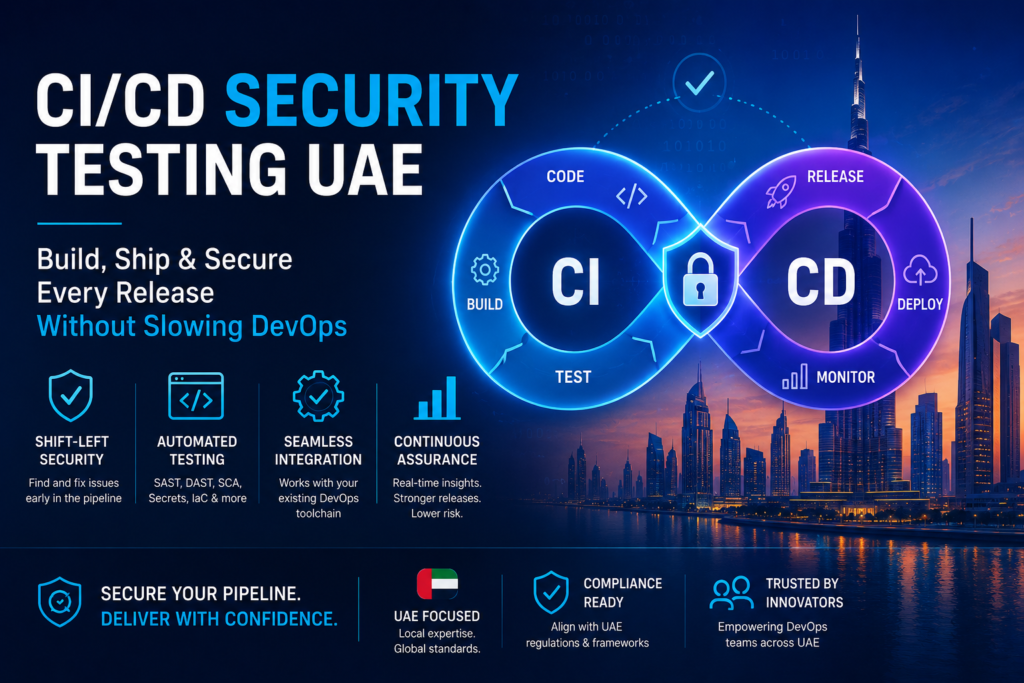
CI/CD (Continuous Integration/Continuous Deployment) security testing means embedding security checks directly into your build and release pipeline, instead of testing an application only after it’s already in production.
In practice, it means every code commit, build, and deployment automatically passes through security checks such as the following:
- Static Application Security Testing (SAST): Scanning source code for flaws before it’s compiled
- Software Composition Analysis (SCA): Checking open-source libraries and dependencies for known vulnerabilities
- Secrets scanning: Catching hardcoded API keys, passwords, and tokens before they ship
- Dynamic Application Security Testing (DAST): Testing the running application for exploitable issues
- Container and Infrastructure-as-Code (IaC) scanning: Checking Docker images, Kubernetes configs, and cloud templates for misconfigurations
The goal is simple: catch vulnerabilities where they’re cheapest and fastest to fix, in the pipeline, not after attackers find them in production.
Why UAE Businesses Need CI/CD Security Testing Now
The UAE’s digital economy is expanding fast. Startups and enterprises across Dubai, Abu Dhabi, and the wider Emirates are shipping products faster than ever, often using agile and DevOps practices to stay competitive. But speed without security creates real exposure.
A few reasons this matters right now:
- Faster releases mean faster mistakes. Weekly or daily deployments leave little room for manual, end-of-cycle security reviews.
- Cloud-native stacks add complexity. Most UAE businesses now run on AWS, Azure, or hybrid cloud environments, which introduces new attack surfaces at every deployment.
- Regulatory pressure is increasing. Sectors like finance, healthcare, and government in the UAE face growing compliance expectations around data protection and application security.
- Attackers move fast too. A vulnerability introduced today can be discovered and exploited within days, not months.
CI/CD security testing directly addresses this by making security a continuous, automated part of how software gets built, not a once-a-year checkbox.
CI/CD Security Testing and DevSecOps: How They Connect
CI/CD security testing is the practical engine behind DevSecOps Security Services UAE. DevSecOps is the broader philosophy; security is everyone’s responsibility, built in from day one. CI/CD security testing is how that philosophy actually gets implemented inside your build pipeline.
A mature DevSecOps setup typically includes:
- Automated security gates at each pipeline stage, so builds fail fast on critical issues
- Developer-friendly reporting that explains what’s wrong and how to fix it, not just a raw scanner output
- Prioritization based on real exploitability and business impact, not just severity scores from a tool
- A feedback loop so recurring issues get addressed at the source, not patched repeatedly
Done well, this doesn’t slow your DevOps team down. It removes the late-stage scramble that happens when security is bolted on right before a release deadline.
Application and API Security Testing Inside the Pipeline
Two areas deserve special attention inside any CI/CD security program:
Application Security Testing UAE
Modern applications, web and mobile, are the primary interface between your business and your customers. Embedding Application Security Testing UAE into your pipeline means every build is checked for issues like the following:
- Broken authentication and session handling
- Injection flaws (SQL, command, and code injection)
- Insecure data storage and transmission
- Business logic flaws that automated scanners often miss
API Security Testing Dubai
APIs now connect your mobile apps, payment systems, third-party integrations, and internal services. A single unprotected endpoint can expose sensitive data at scale. API Security Testing Dubai inside your pipeline should specifically validate the following:
- Authentication and authorization controls on every endpoint
- Rate limiting to prevent abuse and scraping
- Data exposure, making sure APIs don’t return more information than intended
- Broken object-level authorization (a leading cause of API breaches globally)
Since APIs and applications are often updated multiple times a week, testing them only once a year leaves long windows of exposure. Pipeline-integrated testing closes that gap.
Cloud Security Assessment UAE: Securing Where You Deploy
Most CI/CD pipelines deploy directly into cloud environments, such as AWS, Azure, GCP, or a hybrid setup. This means your pipeline’s security is only as strong as the cloud infrastructure it deploys into.
A proper Cloud Security Assessment UAE as part of your pipeline should look at the following:
- Misconfigured storage buckets and databases left publicly accessible
- Overly permissive Identity and Access Management (IAM) roles
- Unencrypted data at rest or in transit
- Missing logging and monitoring on cloud workloads
- Container orchestration risks in Kubernetes and Docker environments
For UAE businesses operating across hubs such as DIFC, Business Bay, Dubai Internet City, and Abu Dhabi’s ADGM, cloud misconfigurations are among the most common, and most preventable, causes of data exposure.
Where VAPT Fits Into a CI/CD Security Program
Vulnerability Assessment and Penetration Testing UAE (VAPT) and CI/CD security testing work together, not separately.
- Automated pipeline scans catch known vulnerabilities and misconfigurations on every build
- Periodic or continuous VAPT goes deeper, simulating real-world attacker behavior to find issues automated tools miss, such as chained exploits and business logic flaws
Many UAE businesses now combine both through a Penetration Testing as a Service (PTaaS) model, aligning testing cycles with release schedules, monthly, quarterly, or per major release, so new features never go live without security validation.
Building a Secure Software Development Lifecycle (SSDLC)
CI/CD security testing works best when it’s part of a larger Secure Software Development Lifecycle (SSDLC), with security built in at every phase of development, not just at the pipeline stage.
A practical SSDLC includes the following:
- Requirements: Defining security and compliance requirements upfront
- Design: Threat modeling before a single line of code is written
- Development: Secure coding standards and peer review
- Build & Test: Automated CI/CD security testing (SAST, SCA, DAST, secrets scanning)
- Deployment: Cloud and infrastructure security checks before go-live
- Maintenance: Continuous monitoring, retesting, and patching
This shift-left approach means vulnerabilities are caught and fixed early, when they’re far cheaper and faster to resolve than after release.
Key Benefits for UAE Businesses
- Faster, safer releases: Security checks run automatically, without manual bottlenecks
- Lower remediation costs: Fixing issues in development is significantly cheaper than post-release patching
- Stronger compliance posture: Supports audit and regulatory requirements across finance, healthcare, and government sectors
- Reduced breach risk: Vulnerabilities are caught before attackers find them
- Developer buy-in: Clear, actionable findings instead of noisy, unusable scan reports
- Business continuity: Fewer emergency patches, fewer late-night incident calls
Who This Applies To
CI/CD security testing is relevant across nearly every industry building or maintaining software in the UAE, including:
- Fintech and payment platforms
- Healthcare technology providers
- E-commerce and retail platforms
- SaaS and technology companies
- Government and public sector digital services
- Hospitality and travel platforms
If your team runs a build pipeline and deploys code regularly, this applies to you, regardless of company size.
How the Process Typically Works
- Scope and assess: Review your current pipeline, tools, and release cadence
- Integrate security gates: Add SAST, SCA, secrets scanning, and DAST at appropriate pipeline stages
- Test applications, APIs, and cloud configs: Combine automated scans with expert-led testing
- Prioritize findings by real business impact: Not just raw severity scores
- Support remediation: Give developers clear, actionable fixes
- Retest and verify closure: Confirm vulnerabilities are actually resolved
- Repeat continuously: Aligned with your release schedule, not a once-a-year calendar event
FAQ
Does CI/CD security testing slow down releases?
No, when integrated properly, automated checks run in parallel with your existing pipeline, and only flag builds with genuine, verified risks. This avoids the last-minute scramble that comes from testing after development is already finished.
How is this different from a one-time penetration test?
A one-time VAPT engagement checks your application at a single point in time. CI/CD security testing runs continuously, catching new vulnerabilities introduced with every code change or new release.
Do small and mid-sized UAE businesses need this, or only large enterprises?
Any business shipping software regularly benefits. Smaller teams often have less capacity to catch issues manually, which makes automated pipeline security even more valuable.
Can this help with compliance requirements?
Yes. A documented, continuous testing process supports audit readiness and regulatory expectations that are common across the UAE finance, healthcare, and government sectors.
Secure Every Release, Without Slowing Your Team Down
If your organization is ready to build security into every release instead of chasing vulnerabilities after they go live, our team can help you design and implement a CI/CD security testing program tailored to your UAE business, without disrupting your DevOps workflow.