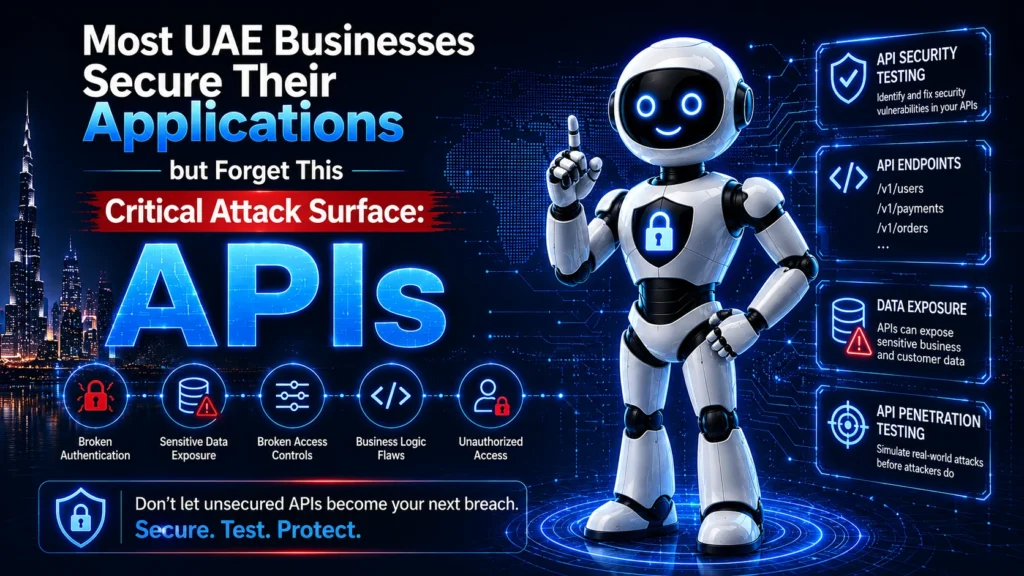
Organizations across the UAE are investing heavily in cybersecurity through firewalls, endpoint protection, cloud security, and vulnerability management. However, many still overlook one of the fastest-growing attack surfaces in modern environments: APIs.
As businesses accelerate digital transformation, APIs have become the backbone of mobile applications, cloud services, customer portals, payment systems, and third-party integrations. While APIs enable innovation and connectivity, they also create direct pathways to sensitive business data when not properly secured.
APIs Now Dominate Enterprise Traffic
Modern enterprises are increasingly API-driven. Industry research indicates that APIs account for more than 80% of internet traffic, making them a primary target for cybercriminals.
Many organizations deploy APIs faster than they can properly inventory and secure them. This often leads to the creation of shadow APIs, undocumented endpoints operating outside established security controls. These hidden APIs frequently become attractive targets because they receive little or no security monitoring.
Why Attackers Target APIs
Unlike traditional web applications, APIs provide direct access to backend systems and critical data. Attackers increasingly target APIs to:
- Access sensitive customer information
- Exploit authentication weaknesses
- Abuse authorization flaws
- Manipulate business transactions
- Extract financial and business data
- Exploit business logic vulnerabilities
Many API attacks use legitimate requests and valid credentials, making them difficult for traditional security solutions to detect.
Critical API Security Risks
According to the OWASP API Security Top 10, the most common API vulnerabilities in UAE include:
- Broken Object Level Authorization (BOLA)
Allows attackers to access resources belonging to other users through improper authorization checks. - Broken Authentication
Weak authentication mechanisms enable account compromise and unauthorized access. - Excessive Data Exposure
APIs expose more information than necessary, increasing the risk of sensitive data leakage. - Broken Function-Level Authorization
Users gain access to administrative or privileged functions they should not be able to reach. - Security Misconfiguration
Improperly configured APIs expose sensitive information and create exploitable weaknesses.
UAE Organizations Face Growing API Risks
The UAE’s rapid adoption of cloud computing, fintech, smart government services, AI platforms, and digital transformation initiatives has dramatically increased API usage across sectors including:
- Banking and
- Financial Services
- Healthcare
- Government
- Telecommunications
- Retail and E-commerce
- Energy and Utilities
As organizations connect more systems through APIs, a single vulnerable endpoint can expose multiple business processes and sensitive datasets.
What Security Frameworks Recommend
Research from Architecting Scalable Enterprise API Security Using OWASP and NIST Protocols in Multinational Environments highlights several essential controls:
- API Discovery and Inventory Management
- Strong Authentication and Authorization
- Continuous API Security Testing in UAE
- API Penetration Testing
- Runtime Monitoring and Threat Detection
- Secure API Development Lifecycle
- NIST-Compliant Security Controls
- OWASP API Security Best Practices
Traditional Security Is No Longer Enough
Firewalls, endpoint protection, and network monitoring remain important, but they are not designed to stop modern API attacks. Threat actors increasingly exploit weaknesses in authentication, authorization, and business logic while appearing as legitimate users.
This makes API Security Testing in UAE, API Vulnerability Assessment, and API Penetration Testing essential components of modern cybersecurity programs.
Conclusion
As UAE businesses continue expanding their digital ecosystems, API Security is becoming a business-critical requirement rather than a technical recommendation.
Organizations that invest in API Security Testing, OWASP API Security Assessments, Continuous Penetration Testing, and NIST-aligned API Protection will be better positioned to prevent data breaches, maintain compliance, and protect customer trust.