
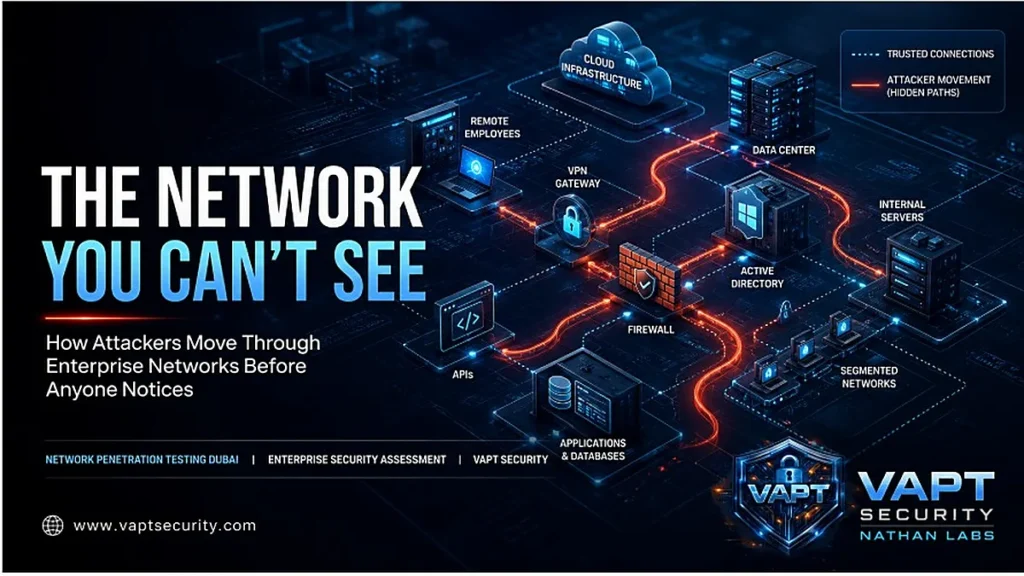
When organizations think about cyberattacks, they often imagine a firewall being breached or malware instantly encrypting every server.
Reality is usually much quieter.
Most successful attacks don’t begin with dramatic alarms or obvious system failures. They begin with something that appears completely normal, like a VPN login, a forgotten server, a misconfigured firewall rule, or an employee’s credentials being used from an unexpected location.
The attacker doesn’t rush.
They observe.
They map.
They learn.
Long before sensitive data is accessed or business operations are disrupted, an invisible journey is already underway inside the network.
This is exactly why Network Penetration Testing Dubai has become an essential component of modern cybersecurity. Instead of waiting for attackers to discover hidden weaknesses, organizations proactively evaluate how an attacker could move through their network before a real incident occurs.
The Network Looks Secure… Until You Look Closer
Imagine arriving at your office on Monday morning.
Employees are working.
Emails are flowing.
Applications are responding normally.
Cloud services are available.
Nothing appears unusual.
From the outside, everything seems secure.
But cybersecurity isn’t measured by what users can see.
Enterprise networks consist of hundreds or even thousands of interconnected assets working together:
- Firewalls
- VPN gateways
- Active Directory
- File servers
- Virtual machines
- Cloud workloads
- Wireless networks
- Remote access services
- Backup systems
- Employee workstations
Every device, service, and connection expands the organization’s attack surface.
An attacker only needs one overlooked weakness to begin exploring the environment.
The Front Door Isn't Always the Firewall
Many organizations invest heavily in perimeter security.
Firewalls are configured.
VPN access is protected.
Endpoint protection is deployed.
Yet attackers often avoid attacking these controls directly.
Instead, they look for easier entry points.
Examples include:
- A forgotten VPN account that was never disabled.
- An exposed management interface.
- Weak passwords reused across multiple systems.
- Outdated software that hasn’t been patched.
- Misconfigured remote access services.
- Legacy infrastructure still connected to the production network.
These weaknesses don’t necessarily create an immediate breach.
They create an opportunity.
And opportunities are exactly what attackers search for.
A well-executed Cyber Security Assessment UAE helps organizations identify these exposure points before they become part of an attack path.
Once Inside, Everything Changes
Contrary to popular belief, attackers rarely begin by stealing data.
Their first objective is understanding the environment.
Once they establish an initial foothold, they begin collecting information.
Questions they attempt to answer include:
- What operating systems are being used?
- Which servers contain critical business data?
- Where is the domain controller?
- How are users authenticated?
- Which cloud services are connected?
- Are privileged accounts accessible?
- Which systems communicate with each other?
Every answer makes the next step easier.
Instead of attacking randomly, they gradually build a map of the organization.
This process often happens quietly, generating little visible disruption.
Every Device Tells Part of the Story
Enterprise networks are no longer limited to desktops and servers.
Today’s environments may also include:
- Wireless access points
- Network switches
- IP cameras
- IoT devices
- Storage appliances
- Virtualization platforms
- Cloud gateways
- Remote workforce laptops
- Development environments
- Backup infrastructure
Individually, these devices may appear low risk.
Collectively, they reveal valuable information about how the organization operates.
For example, a network printer may expose naming conventions.
A forgotten development server may reveal software versions.
An unsecured management interface may disclose internal network architecture.
Attackers don’t always need sensitive data immediately.
Sometimes they only need enough information to identify where to move next.
Small Weaknesses Become Larger Problems
One vulnerability rarely causes a major security incident by itself.
The real danger comes from combining multiple weaknesses.
Consider a simple sequence.
An exposed VPN account provides initial access.
↓
A weak password allows access to another internal system.
↓
Poor network segmentation enables movement between departments.
↓
An overprivileged account grants administrative access.
↓
Sensitive business systems become accessible.
Each weakness appears relatively minor when viewed independently.
Together, they create a pathway through the network.
Understanding these relationships is one of the primary goals of Infrastructure Penetration Testing UAE, where security professionals assess not only individual vulnerabilities but also how they can be chained together during a realistic attack scenario.
The Invisible Journey Through the Network
Many organizations focus on preventing unauthorized access.
While prevention remains essential, equally important is understanding what happens after an attacker gains an initial foothold.
Can they move between systems?
Can they discover administrative credentials?
Can they access cloud resources?
Can they reach critical business applications?
Can they interact with backup systems?
Can they pivot toward sensitive databases?
These questions cannot always be answered through automated vulnerability scanning alone.
They require understanding how trust relationships, permissions, authentication mechanisms, and network architecture interact within the environment.
This broader perspective is what makes Network Penetration Testing Dubai significantly different from simply identifying individual vulnerabilities.
Modern Networks Extend Beyond the Office
Today’s enterprise network doesn’t end at the office firewall.
Employees connect remotely.
Applications communicate with cloud platforms.
Third-party vendors access business systems.
Development teams deploy infrastructure through automated pipelines.
APIs exchange information across multiple environments.
Business operations now span on-premises infrastructure, cloud services, SaaS platforms, and remote endpoints.
As organizations expand digitally, attackers gain more pathways to explore.
This is why many organizations combine Cloud Security Services UAE, Continuous Penetration Testing Services UAE, and traditional network assessments to maintain visibility across evolving environments rather than viewing network security as a one-time exercise.
How Network Penetration Testing Interrupts the Attack Chain
Attackers succeed because they think in sequences rather than individual vulnerabilities.
Security professionals should do the same.
A professional Network Penetration Testing Dubai engagement isn’t simply about running automated scans or producing long vulnerability reports. It evaluates how an attacker could realistically move through an environment by combining multiple weaknesses into an attack path.
A typical assessment follows a structured methodology:
1. Network Discovery
The assessment begins by identifying externally and internally accessible systems.
This includes:
- Firewalls
- VPN gateways
- Remote access services
- Internal subnets
- Network devices
- Domain infrastructure
- Critical servers
Understanding the environment provides the foundation for every subsequent security assessment.
2. Vulnerability Validation
Not every vulnerability represents genuine business risk.
Security professionals validate whether identified weaknesses are actually exploitable rather than relying solely on automated scanner results.
This reduces false positives and helps organizations focus remediation efforts where they matter most.
3. Controlled Exploitation
Where appropriate and within agreed engagement boundaries, identified vulnerabilities are validated through controlled exploitation.
The objective is never disruption.
The objective is understanding:
- What could an attacker actually achieve?
- How far could access extend?
- Which business systems become exposed?
- What level of privilege could realistically be obtained?
4. Privilege Escalation Analysis
Initial access rarely represents the attacker’s final objective.
The assessment evaluates whether limited access could potentially become administrative access through:
- Weak privilege management
- Excessive user permissions
- Credential exposure
- Misconfigured authentication
- Trust relationships between systems
5. Lateral Movement Assessment
Modern attacks rarely remain confined to one device.
Security professionals evaluate whether movement between systems is possible through:
- Shared administrative credentials
- Weak segmentation
- Insecure remote management
- Domain trust relationships
- Misconfigured internal services
This stage helps organizations understand how a localized compromise could affect the broader enterprise.
6. Risk Prioritization
Finally, technical findings are translated into business risk.
Instead of presenting a list of vulnerabilities ranked only by severity scores, findings are prioritized according to exploitability, business impact, affected assets, and remediation priority.
This allows leadership teams to make informed security decisions based on operational risk rather than technical complexity alone.
Reactive Security vs Network Penetration Testing
Reactive Security | Network Penetration Testing |
|---|---|
Responds after suspicious activity is detected | Identifies weaknesses before attackers exploit them |
Depends on existing alerts | Simulates realistic attack paths |
Focuses on individual security events | Evaluates the complete attack surface |
Investigates incidents after they occur | Helps reduce the likelihood of successful compromise |
Primarily operational | Supports long-term risk reduction |
Both approaches are important.
Security monitoring helps detect ongoing threats, while penetration testing helps identify weaknesses that could enable those threats in the first place.
Seven Network Blind Spots Organizations Often Miss
Even mature IT environments can develop hidden exposure points over time.
Some of the most common include:
Forgotten Remote Access Services
Legacy VPN accounts, Remote Desktop services, or management interfaces that remain accessible long after they should have been retired.
Flat Network Architecture
Insufficient network segmentation allows attackers to move more freely once initial access has been obtained.
Excessive Administrative Privileges
Users and service accounts often retain permissions that exceed operational requirements.
Legacy Infrastructure
Older operating systems, unsupported applications, and forgotten servers frequently become attractive targets.
Cloud Connectivity
Modern enterprise networks extend into cloud environments, making Cloud Security Services UAE an important complement to traditional network assessments.
Third-Party Access
Vendor connections and external integrations can unintentionally expand the organization’s attack surface if not reviewed regularly.
Security Drift
Network environments evolve continuously.
Infrastructure changes, firewall modifications, cloud deployments, and new business applications gradually alter the security posture.
This is one reason many organizations combine periodic assessments with Continuous Penetration Testing Services in the UAE, helping ensure that security keeps pace with ongoing operational change.
Enterprise Network Security Checklist
Before considering your network secure, ask:
- Are unnecessary VPN accounts removed?
- Is administrative access limited to essential personnel?
- Are internal network segments appropriately separated?
- Are firewall rules reviewed regularly?
- Are legacy systems identified and managed?
- Are cloud-connected assets included in security assessments?
- Have critical infrastructure components undergone penetration testing?
- Are remediation efforts independently verified?
- Are privileged accounts continuously monitored?
- Is network security reviewed after significant infrastructure changes?
FAQ
What is Network Penetration Testing?
Network penetration testing is a structured security assessment that evaluates how attackers could exploit weaknesses within an organization’s network infrastructure, systems, and trust relationships under controlled conditions.
How often should organizations perform network penetration testing?
Testing frequency depends on infrastructure changes, regulatory requirements, business risk, and the organization’s security strategy. Many organizations perform assessments after significant infrastructure modifications or on a periodic basis as part of their cybersecurity program.
Is network penetration testing different from vulnerability scanning?
Yes.
Vulnerability scanning identifies potential weaknesses.
Penetration testing validates exploitability, evaluates attack paths, and helps determine actual business risk.
Does cloud infrastructure require network penetration testing?
Cloud environments remain part of an organization’s overall attack surface. Assessing cloud connectivity, identity configurations, and supporting infrastructure complements traditional network security assessments.
Conclusion
Most successful cyberattacks don’t begin with dramatic system failures.
They begin quietly.
A forgotten account.
An overlooked firewall rule.
A trusted connection.
A small configuration mistake.
Individually, these issues may appear insignificant.
Together, they can create an invisible path through an enterprise network.
Network Penetration Testing Dubai helps organizations discover these hidden pathways before attackers do. By evaluating network architecture, authentication mechanisms, privilege management, segmentation, and trust relationships, organizations gain a clearer understanding of where genuine business risks exist.
Combined with Cyber Security Assessment UAE, Infrastructure Penetration Testing UAE, Cloud Security Services UAE, and Continuous Penetration Testing Services UAE, network penetration testing becomes an important part of building a resilient security strategy capable of adapting to modern enterprise environments.
Strengthen Your Network Security with Nathan Labs
Nathan Labs provides structured security assessments covering network infrastructure, web applications, APIs, cloud environments, and broader cybersecurity testing. Engagements are designed to help organizations identify exploitable vulnerabilities, understand potential business impact, and support effective remediation through practical recommendations and vulnerability re-testing.