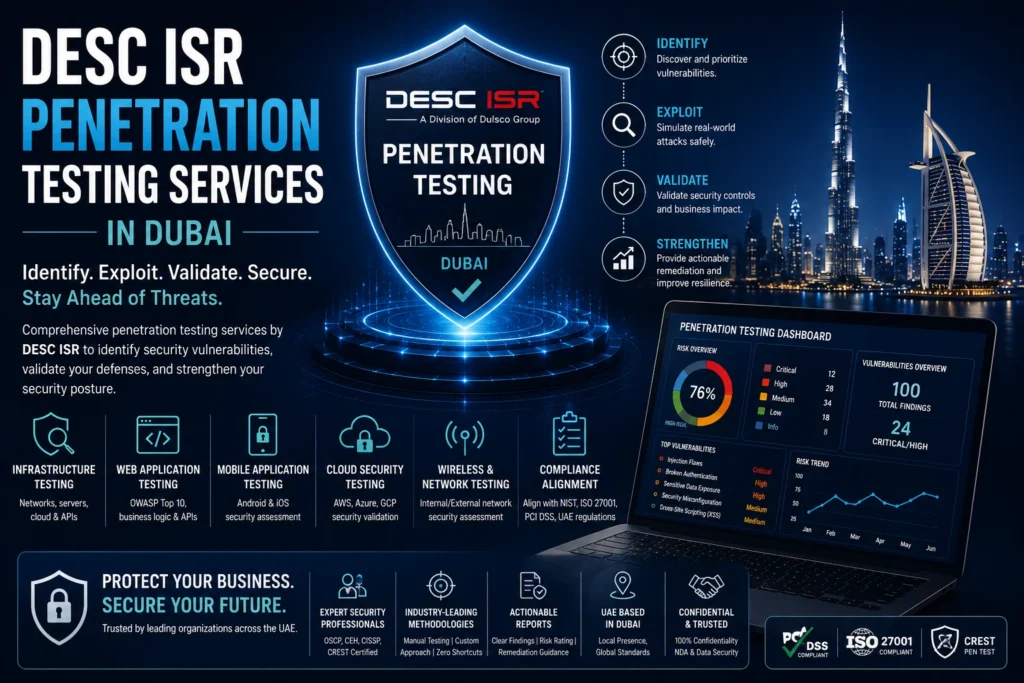
DESC ISR Penetration Testing Services in Dubai
DESC ISR compliance isn’t satisfied with policies alone. Domain 13 of the Information Security Regulation, Compliance, and Audit specifically requires technical assessments like penetration testing to prove your controls work in practice, not just on paper. Nathan Labs delivers DESC ISR-aligned penetration testing for Dubai government entities, semi-government bodies, and the private vendors who serve them, so your compliance evidence holds up when DESC comes calling.
What Is DESC ISR, and Why Does Penetration Testing Matter?
The Dubai Electronic Security Center (DESC) is the government authority responsible for cybersecurity across Dubai. Its Information Security Regulation (ISR) is the mandatory framework every Dubai government entity, semi-government body, and key technology supplier must implement. The current version, ISR v3, is structured across thirteen security domains, spanning governance, risk management, access control, cryptography, secure development, supplier security, incident response, business continuity, and SOC operations.
Domain 13, Compliance and Audit, is where penetration testing sits. It exists to verify that the controls implemented across the other twelve domains actually function as intended, because a documented policy means nothing if the underlying system is still exploitable. DESC assessors expect to see penetration test reports, remediation evidence, and confirmation that issues were retested and closed, not just a checklist marked complete.
Who Needs DESC ISR Penetration Testing?
- Dubai government departments and semi-government entities
- Private sector vendors and IT suppliers serving Dubai government clients
- Cloud Service Providers (CSPs) seeking DESC CSP certification
- Security Operations Centres (SOCs) providing services to government entities
- Organizations operating critical infrastructure or Industrial Control Systems (OT) in Dubai
If your business connects to Dubai government networks, handles government data, or supplies technology services under a government contract, ISR requirements, including penetration testing, extend to you, even as a private-sector vendor.
How Often Does DESC ISR Require Penetration Testing?
ISR v3 sets a risk-based testing schedule tied to system criticality:
- Annual penetration testing for all external-facing services
- Quarterly vulnerability assessments across all systems in scope
- Bi-annual comprehensive testing for critical infrastructure
- Retesting after significant system changes, new deployments, or major incidents
Testing that lapses or findings that sit open across audit cycles are among the most common reasons entities fail DESC assessments. Assurance activities like penetration testing are frequently under-resourced compared to control implementation, and it’s exactly where auditors focus.
How Nathan Labs Delivers DESC ISR-Aligned Penetration Testing
- Scoping against ISR domains: We map your in-scope systems, web applications, APIs, cloud environments, internal networks, and OT/ICS where applicable against the specific ISR domains your assessment needs to demonstrate, rather than running a generic test.
- External and internal penetration testing: We test external-facing services required under the annual mandate, along with internal network, application, API, and wireless testing depending on your risk classification and scope.
- Cloud and CSP-specific testing: For organizations running on Azure, AWS, or GCP or pursuing DESC CSP certification, we test cloud configurations, identity and access management, data isolation, and encryption controls against ISR’s cloud security provisions.
- Exploitation, not just scanning: Automated scans identify known weaknesses. Our testers go further, manually chaining findings into real attack paths to demonstrate actual business impact, which is what Domain 13 assurance is built to verify.
- Audit-ready reporting: Every engagement produces an executive summary your leadership and DESC auditors can use to confirm compliance status, plus a detailed technical report your engineering team can act on directly.
- Retesting and closure evidence: We retest remediated findings and document closure, so your ISR compliance file shows resolved risk, not a growing backlog of open findings across assessment cycles.
- Continuous testing support: Given ISR’s quarterly and annual cadences, we offer Penetration Testing as a Service (PTaaS) to keep your evidence current between formal DESC assessments, rather than treating testing as a once-a-year scramble.
Why Dubai Organizations Choose Nathan Labs for DESC ISR Penetration Testing
- Domain-mapped scoping: Testing tied directly to the ISR domains and control objectives your assessment needs to evidence.
- Full attack surface coverage: Web, mobile, API, network, cloud, and OT/ICS testing under one engagement.
- Risk-based prioritization: Findings ranked by exploitability and business impact, so remediation effort goes where it matters.
- Two-track reporting: Clear evidence for auditors and leadership, technical depth for your IT and development teams.
- Retesting included: Every finding is tracked to verified closure.
- Dubai-based delivery: Direct familiarity with DESC’s assessment expectations across government, CSP, SOC, and critical infrastructure engagements.
Frequently Asked Questions
Yes. ISR v3 requires annual penetration testing for external-facing services, quarterly vulnerability assessments, and bi-annual comprehensive testing for critical infrastructure as part of Domain 13's compliance and audit requirements.
Dubai government and semi-government entities and any private vendor, including IT suppliers, cloud providers, and SOC operators, that handles government data or serves government clients under contract.
Unresolved findings are one of the most common reasons entities fail DESC assessments. Non-compliance can result in removal from government procurement lists and contract termination.
Yes. Cloud service providers pursuing DESC CSP certification, and any entity running government workloads on Azure, AWS, or GCP, need testing that covers cloud configuration, access control, and data isolation.
ISR v3 aligns closely with ISO 27001, and an existing ISMS can cover much of the groundwork. However, ISR adds Dubai-specific testing frequency requirements and assurance evidence that ISO 27001 alone doesn't mandate.