Healthcare and financial organisations are trusted with some of the most sensitive information a person can share. A hospital stores patient records, lab reports, prescriptions and insurance details. A bank or fintech platform manages account information, payment data, KYC documents and financial transactions. When this type of data is exposed, the damage is not limited to IT systems. It can affect people, business reputation, regulatory confidence and long-term customer trust.
Across Dubai, the UAE, Saudi Arabia and the wider GCC, digital services are growing quickly. Hospitals are using patient portals and telemedicine platforms. Banks and fintech companies are expanding mobile banking, digital wallets, online onboarding and API-based services. These improvements make services faster and more convenient, but they also create new entry points for cyberattacks.
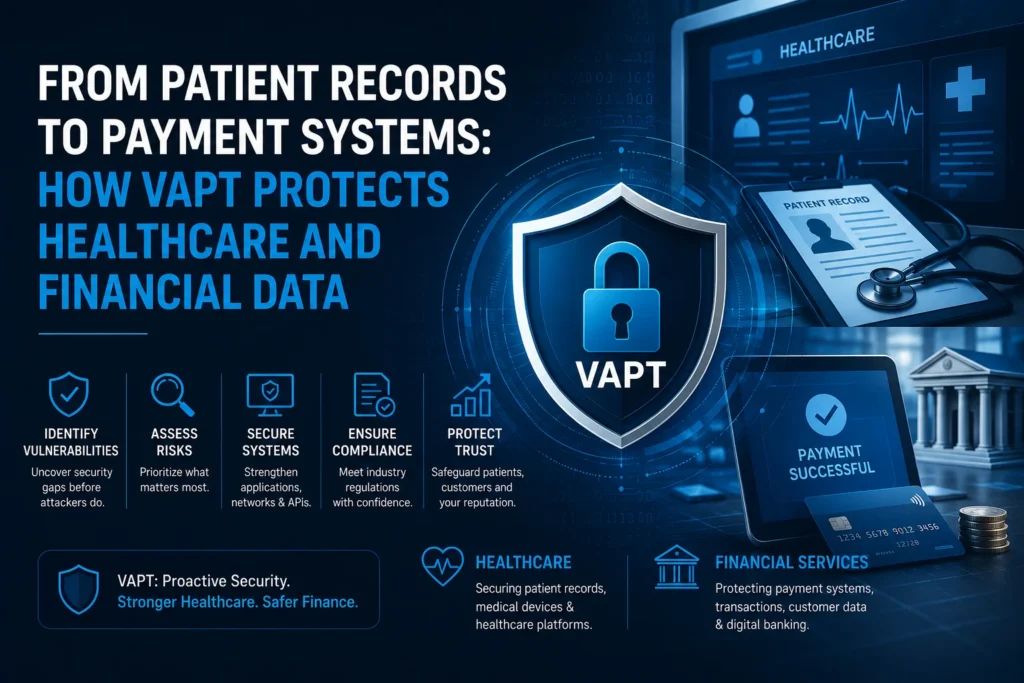
This is why cybersecurity has become a board-level concern for healthcare, banking and financial services. Organisations can no longer wait for an incident before reviewing their security. They need to find weaknesses early, fix them properly and prove that sensitive data is being protected. One of the most effective ways to do this is through Vulnerability Assessment and Penetration Testing, commonly known as VAPT.
VAPT helps identify weaknesses in websites, mobile applications, APIs, servers, databases, cloud platforms, internal networks and other digital systems. More importantly, it shows how serious those weaknesses are and what must be done to reduce the risk.
1. Why Healthcare Needs Strong Cybersecurity
Healthcare data is extremely personal. A patient record may include medical history, diagnosis information, prescriptions, radiology reports, lab results, billing information, insurance claims and identity details. If this information is leaked or misused, the consequences can be serious for both the patient and the healthcare provider.
A cyberattack on a healthcare organisation can also disturb daily operations. Appointment systems may stop working. Doctors may lose access to electronic medical records. Pharmacy, billing or laboratory systems may be affected. In healthcare, downtime is not just a business problem. It can directly impact service delivery.
This makes cybersecurity important for hospitals, clinics, diagnostic centres, laboratories, pharmacies, telemedicine providers, healthcare software companies, insurance providers and mobile healthcare application owners.
Healthcare VAPT focuses on systems that store, process or transmit patient information. It checks whether patient portals are secure, whether APIs are protected, whether access rights are properly controlled and whether sensitive health data can be reached by unauthorised users.
For healthcare providers in Dubai, Abu Dhabi, Saudi Arabia and other GCC markets, this is especially important because patients, regulators, insurers and partners are paying closer attention to data protection and privacy.
Nathan Labs helps healthcare organisations review their security posture through web application VAPT, mobile app security testing, network vulnerability assessment, cloud security review and compliance-focused reporting. The purpose is not only to identify vulnerabilities, but also to explain the business impact and guide the team on practical fixes.
2. Why Banking and Financial Services Are Prime Targets
Banks and financial services companies operate in a high-risk environment. They manage money, personal identity data, transaction records, card details, loan files, investment information, and payment credentials. This makes them attractive targets for cybercriminals.
A weakness in a mobile banking app, fintech platform, payment gateway, customer portal, or API can result in fraud, account takeover, data leakage, unauthorized transactions, and loss of customer confidence. For financial organisations, trust is one of the strongest business assets. Once damaged, it is difficult to rebuild.
Dubai and the UAE have become important centers for banking, fintech, and digital payment services. Saudi Arabia is also expanding rapidly in digital banking, fintech innovation, and cashless payment adoption. Across the GCC, customers expect fast, secure, and reliable digital financial services.
Banking VAPT and financial services penetration testing help organizations test their critical systems before attackers do. This may include internet banking platforms, mobile banking applications, customer onboarding portals, payment systems, APIs, cloud infrastructure, databases, and internal networks.
Nathan Labs supports banks, fintech companies, payment service providers, insurance firms, and other financial institutions with tailored VAPT services. These services include web application penetration testing, mobile application security testing, API security testing, network VAPT, cloud security assessment, and configuration review.
3. What VAPT Really Does
VAPT is a combination of two activities: vulnerability assessment and penetration testing.
A vulnerability assessment identifies possible weaknesses in systems, applications, and infrastructure. Penetration testing goes deeper by checking whether those weaknesses can actually be exploited in a real-world attack scenario.
In simple terms:
1. Vulnerability assessment finds the weak points.
2. Penetration testing proves how risky they are.
3. The final report gives a clear path for fixing them.
A proper VAPT exercise helps answer important questions. Which systems are exposed? What vulnerabilities exist? Can an attacker exploit them? What data could be affected? Which issues need urgent attention? What should the technical team fix first?
For healthcare, banking, and financial services, this clarity is important because these sectors cannot depend only on firewalls, antivirus tools, or basic IT monitoring. They need deeper security testing that reflects real business risk.
Nathan Labs follows a risk-based approach where findings are explained in both technical and business terms. This helps IT teams understand the fix, while management understands the risk and priority.
4. Common Security Gaps Found During VAPT
Many organizations assume they are secure because they have firewalls, antivirus software, IT support, or cloud service providers. However, security testing often reveals gaps that are not visible in daily operations.
Common issues found during VAPT include weak passwords, missing patches, open ports, unnecessary services, insecure APIs, SQL injection, cross-site scripting, broken access control, insecure file upload, weak encryption, exposed admin panels, default credentials, poor session management, cloud misconfiguration, and sensitive data exposure.
In healthcare, such weaknesses may expose patient records, medical reports, appointment details, or insurance information. In banking and financial services, they may expose account details, cardholder data, payment records, or confidential financial documents.
Nathan Labs combines automated testing with manual validation to reduce false positives and identify real attack paths. This gives clients a cleaner, more useful report that can be acted on quickly.
5. VAPT and Compliance Readiness
For regulated sectors, cybersecurity is closely linked with compliance. Healthcare, banking, and financial services organisations may need to align with ISO 27001, ISO 27701, PCI DSS, the UAE Personal Data Protection Law, the Saudi Personal Data Protection Law, healthcare data protection requirements, cloud security expectations, internal security policies, and customer security requirements.
A VAPT report can support internal audits, external audits, ISO certification audits, PCI DSS assessments, vendor reviews, customer security assessments, board reviews, and management reporting.
Nathan Labs helps clients connect VAPT findings with wider compliance needs. This is useful for organizations preparing for ISO 27001 certification, PCI DSS readiness, privacy reviews, third-party assessments, or cybersecurity governance improvements.
A good VAPT report should not only list technical findings. It should explain the risk, affected system, business impact, proof of concept, recommended fix, and retesting result. This makes the report useful for technical teams, compliance teams, and decision-makers.
6. How Nathan Labs Can Support Your Organisation
Nathan Labs provides cybersecurity, VAPT, compliance, and information security consulting services for organizations that want to identify risks and strengthen protection. The focus is practical: find the weakness, explain the risk, guide the fix, and verify closure.
Nathan Labs can support healthcare, banking, and financial services clients through the following:
1. Web Application VAPT
Testing websites, patient portals, banking portals, fintech platforms, and customer portals for vulnerabilities such as SQL injection, cross-site scripting, broken authentication, access control issues, and sensitive data exposure.
2. Mobile Application Penetration Testing
Assessing healthcare apps, mobile banking apps, fintech apps, and insurance apps for insecure storage, weak authentication, session handling issues, and API communication risks.
3. API Security Testing
Reviewing APIs used in healthcare integrations, banking systems, payment services, and fintech platforms for broken authentication, poor authorization, data leakage, rate limiting issues, and business logic flaws.
4. Network VAPT
Testing internal and external networks to identify open ports, vulnerable services, outdated systems, insecure protocols, and weak configurations.
5. Cloud Security Assessment
Reviewing cloud environments for misconfiguration, excessive permissions, exposed storage, weak identity controls, and infrastructure risks.
6. Compliance Support
Assisting with ISO 27001 readiness, ISO 27701 privacy support, PCI DSS readiness, cybersecurity documentation, risk assessments, and audit preparation.
7. Remediation Guidance and Retesting
Helping IT and development teams understand how to fix vulnerabilities and performing retesting after closure.
7. Why Regular VAPT is Important
Cybersecurity risks keep changing. New vulnerabilities are discovered, applications are updated, cloud settings are modified, APIs are added, and attackers continue to improve their methods. A system that is secure today may become exposed tomorrow if it is not reviewed regularly.
Healthcare, banking, and financial services organizations should consider VAPT before launching a new application, after major system changes, before going live with a patient portal or payment platform, after cloud migration, after API integration and before compliance audits.
For high-risk systems such as internet banking, payment gateways, electronic medical records, patient portals and fintech applications, periodic VAPT is especially important.
Nathan Labs can help organizations plan VAPT cycles based on business risk, system criticality, compliance needs and operational priorities. This helps clients maintain better visibility over their cybersecurity posture and avoid surprises during audits or security incidents.
Final Thoughts
Healthcare, banking, and financial services organizations cannot afford to treat cybersecurity as an afterthought. These sectors handle patient data, financial records, customer identities, payment details, and other highly sensitive information.
VAPT is one of the most practical ways to identify hidden weaknesses, reduce cyber risk, and improve digital trust. It helps organizations understand where they are exposed and what actions are needed to strengthen protection.
For hospitals, clinics, banks, fintech companies, insurance providers, payment gateways, and financial institutions in Dubai, the UAE, Saudi Arabia, and across the GCC, regular VAPT is a necessary step towards stronger cybersecurity.
Nathan Labs helps organizations protect critical systems through professional VAPT services, cybersecurity consulting, compliance support, remediation guidance, and retesting. Whether the requirement is healthcare cybersecurity, banking VAPT, fintech security testing, API penetration testing, cloud security assessment, or ISO 27001 readiness, Nathan Labs can help identify risks and build stronger protection.
In a digital economy, trust depends on security. Protecting patient data and financial data is not only an IT task. It is a business responsibility.
FAQ
What is VAPT in healthcare and financial services?
Vulnerability Assessment and Penetration Testing (VAPT) is a cybersecurity process that identifies security weaknesses in applications, networks, APIs, cloud environments, and IT infrastructure. It helps healthcare and financial organizations detect vulnerabilities before attackers can exploit them.
Why is VAPT important for hospitals and healthcare providers?
Hospitals store highly sensitive patient information, including medical records, insurance details, and diagnostic reports. VAPT helps protect this data, secures patient portals and healthcare applications, and reduces the risk of cyberattacks that could disrupt critical healthcare services.
Why are banks and fintech companies frequent targets of cyberattacks?
Banks and fintech companies handle financial transactions, customer identities, payment information, and account data. These valuable assets make them attractive targets for cybercriminals seeking financial gain or sensitive information.
What is the difference between vulnerability assessment and penetration testing?
A vulnerability assessment identifies potential security weaknesses, while penetration testing attempts to exploit those weaknesses to determine their real-world impact. Together, they provide a complete picture of an organization’s cybersecurity risks.
Which systems should be included in a VAPT assessment?
A comprehensive VAPT engagement typically includes:
- Web applications
- Mobile applications
- APIs
- Internal and external networks
- Cloud infrastructure
- Databases
- Servers
- Critical business applications
How often should healthcare and financial organizations perform VAPT?
Most organizations should conduct VAPT at least annually. Additional assessments are recommended after major application updates, cloud migrations, infrastructure changes, API integrations, or before compliance audits.
Can VAPT help with regulatory compliance?
Yes. VAPT supports compliance initiatives by identifying security gaps that may affect standards such as ISO 27001, ISO 27701, PCI DSS, UAE Personal Data Protection Law (PDPL), and Saudi Personal Data Protection Law (PDPL).z
What are the most common vulnerabilities found during VAPT?
Some of the most common findings include:
- SQL Injection
- Cross-Site Scripting (XSS)
- Broken Access Control
- Weak Authentication
- Insecure APIs
- Cloud Misconfigurations
- Missing Security Patches
- Sensitive Data Exposure
What happens after a VAPT assessment is completed?
After testing, the organization receives a detailed report outlining identified vulnerabilities, their severity, business impact, recommended remediation steps, and guidance for fixing the issues. A retest is often performed after remediation to verify that vulnerabilities have been successfully addressed.
How can Nathan Labs help secure healthcare and financial organizations?
Nathan Labs provides end-to-end cybersecurity services, including web application VAPT, mobile application security testing, API security testing, network security assessments, cloud security reviews, compliance support, remediation guidance, and retesting for organizations across the UAE, Saudi Arabia, and the GCC.